



blog
2026/11/22
Apply row-level changes to Iceberg with Apache BeamAhmed Abualsaud
You can now use Apache Beam to apply a stream of row-level changes (inserts, updates, deletes) to an Iceberg table by primary key. The merge-on-read sink works in streaming and batch, and it takes changes from any source: another Iceberg table, a database’s change log, or a Kafka topic. Try it with this quickstart.
Applying changes to a table has a few hard parts. The changes have to land in the order they happened. Deletes have to find the rows they remove. And if a commit is retried, or the job restarts, the same change can’t be applied twice. Beam’s CDC sink handles these details for you.
What the sink expects
The sink takes a collection of change rows. Besides the table’s own columns, each row carries two more:
- the change type:
INSERT,UPDATE_BEFORE,UPDATE_AFTERorDELETE - a sequence number that goes up with each change to the same key. Both halves of an update share one.
Here’s a pipeline that applies those changes to sales.orders:

INSERT INTO lakehouse.sales.orders
  WITH ('mode' = 'merge-on-read',
        'change_type_column' = 'op',
        'sequence_number_column' = 'seq',
        'triggering_frequency_seconds' = 10)
SELECT id, item, qty, op, seq FROM order_changes;Map<String, Object> config =
Map.of(
"catalog_properties", catalogProperties,
"table", "sales.orders",
"mode", "merge-on-read",
"equality_columns", List.of("id"),
"change_type_column", "op",
"sequence_number_column", "seq",
"triggering_frequency_seconds", 10);
changes.apply(Managed.write(Managed.ICEBERG).withConfig(config));changes | beam.managed.Write(beam.managed.ICEBERG, config={
"catalog_properties": {...},
"table": "sales.orders",
"mode": "merge-on-read",
"equality_columns": ["id"],
"change_type_column": "op",
"sequence_number_column": "seq",
"triggering_frequency_seconds": 10,
})- type: WriteToIceberg
input: Changes
config:
catalog_properties: {...}
table: sales.orders
mode: merge-on-read
equality_columns: [id]
change_type_column: op
sequence_number_column: seq
triggering_frequency_seconds: 10Setting mode to merge-on-read turns on the CDC sink. equality_columns is the primary key,
and the sink uses it to create the table if it doesn’t exist yet. In SQL, the table has to exist
already, and the key comes from its PRIMARY KEY. The sink drops the op and seq columns before
writing to the table.
If your changes use their own labels, like Debezium’s c, u and d, map them with
change_type_map. If your source doesn’t send a before-image for each update, set upsert to
true, and the sink applies inserts and updates as upserts. For a Debezium stream, that looks
like this:
  WITH (...,
        'change_type_map' = MAP['c', 'INSERT',
                                'u', 'UPDATE_AFTER',
                                'd', 'DELETE'],
'upsert' = true)Map<String, Object> config =
Map.of(
...,
"change_type_map",
Map.of("c", "INSERT", "u", "UPDATE_AFTER", "d", "DELETE"),
"upsert", true);config={
...
"change_type_map": {"c": "INSERT", "u": "UPDATE_AFTER", "d": "DELETE"},
"upsert": True,
}config:
...
change_type_map: {c: INSERT, u: UPDATE_AFTER, d: DELETE}
upsert: trueIf your changes come from Beam’s Iceberg CDC source, point
change_type_column at _change_type. You don’t need to set sequence_number_column, because it
already defaults to _commit_snapshot_sequence_number.
How the sink works
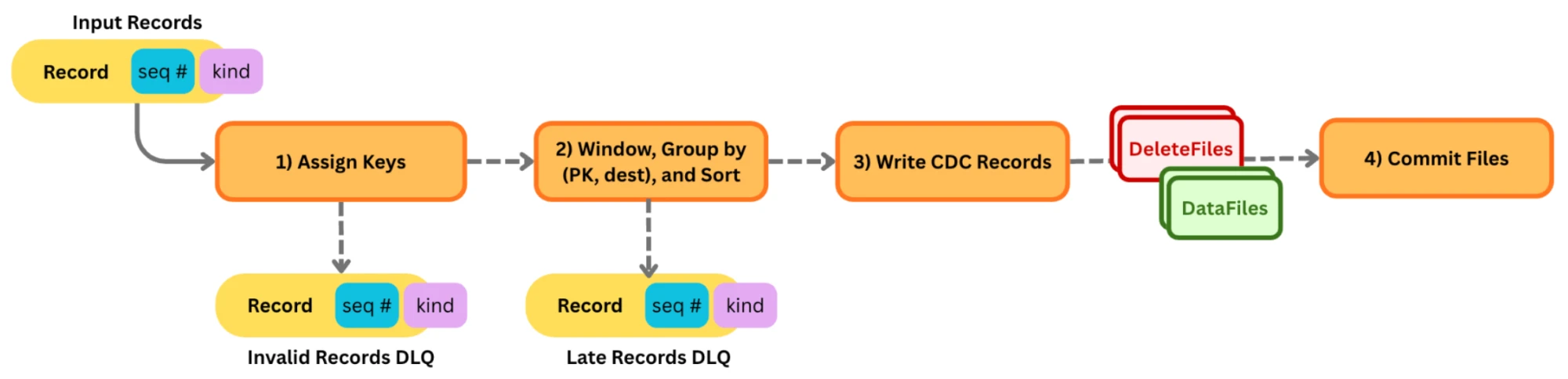
The sink groups changes into commit windows, one every triggering_frequency_seconds in streaming,
and commits each window as a single Iceberg snapshot.
A key’s changes have to be applied in the order they happened, otherwise the table will end up with incorrect values. Beam doesn’t keep elements in order as they move between steps, so the sink sorts each key’s changes by a monotonically increasing sequence number provided by the upstream source.
After the sort, a key’s changes in a given window sit together and in order, so the writer can skip the versions in between. For each key in a window, Beam writes at most one data row (the latest version) and at most one equality delete.
In comparison, the Flink sink writes every change as it arrives, using equality deletes to remove existing records and position deletes to cancel intermediate changes between checkpoints. Here are a few scenarios highlighting the difference in behavior:
| One key’s changes within one window/checkpoint interval | Flink writes | Beam writes |
|---|---|---|
| Existing key, updated twice | 2 data rows, 1 equality delete, 1 position delete | 1 data row, 1 equality delete |
| New key: inserted, updated twice, deleted, inserted again | 4 data rows, 3 position deletes | 1 data row |
Beam’s savings are emphasized for keys that change often within a window. In a batch pipeline, the whole run is one window. The tradeoff cost is that Beam will sort per window, which is an unavoidable sunk cost.
Restarts and late data
Every commit is stamped with the sink’s sink_id and the end of its window. If a commit is
retried, or a streaming job restarts with the same sink_id and window length, the sink reads the
stamps and skips the windows that already landed. Each run gets a random sink_id by default, so
set a fixed one if you plan to restart your job. Don’t reuse sink_id across batch pipelines,
as further reuses will be interpreted as duplicates and will be skipped at commit time.
A change that arrives after its window has closed will be considered late. Instead of landing in the table, it goes
to the sink’s dead_letter output, so watch the deadLetterRecords counter. Changes more than
allowed_lateness_seconds late (six hours by default) are dropped.
Try it
You can use the CDC sink feature starting with the Beam SDK 2.79.0 version, in Java, Python, YAML
and Beam SQL. Java also has IcebergIO.writeCdcRows. This works for table format v2 or v3.
Equality deletes are not allowed in v4, and the sink will later be updated to accommodate for that.
Start with the Iceberg CDC quickstart. Before you go to production, read its production notes. For the design details, see the design doc. To see the sink and Beam’s CDC source working together, read Stream changes between Iceberg tables with Apache Beam.
We’d love to hear how you use this feature. Tell us on the user mailing list or open an issue on GitHub.